
Is the story complete within the frame?
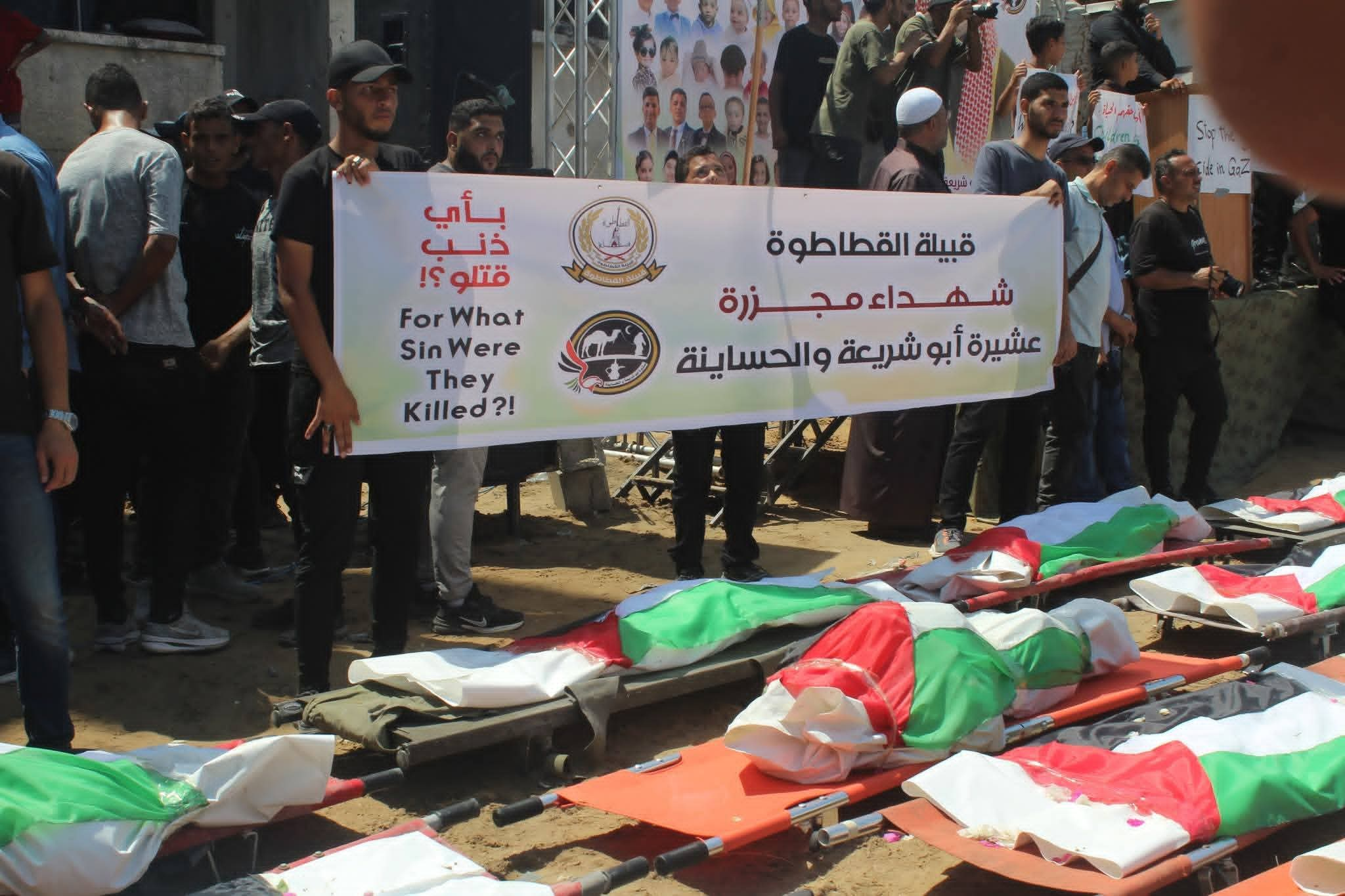
Rows of white shrouds stretch across a narrow courtyard. Men carry coffins side by side, while women wait to bid farewell—a farewell delayed for two full years. One hundred and twelve Palestinians from the Al-Hassaina and Abu Sharia families were finally recovered from beneath the rubble and laid to rest in a collective funeral after war had prevented the retrieval of their bodies for more than two years.
Israel killed them in an airstrike on the building where they had sought refuge during the genocide. Since then, they had remained beneath the ruins. When civil defense crews finally recovered their remains, their entire story seemed to be condensed into a single photograph.
At first glance, the frame appears sufficient. It captures the magnitude of the tragedy and offers visual evidence that is difficult to deny. Yet the question that imposes itself is not, What do we understand from this image? Rather: What idea—far from innocent—does this image carry?
It is this question that led the American writer and critic Susan Sontag to argue in her book Regarding the Pain of Others that no matter how powerful a photograph may be, it does not explain. It presents an event, but not its history, its causes, or the time that preceded it. The photograph tells us these people are being buried today, but it cannot tell us that they died two years earlier; that their families knew where their bodies lay but had no way of reaching them; or that burial itself became a postponed privilege because the war continued.
Every shroud is draped with the four-colored Palestinian flag. Together, the flags almost create a carefully composed visual pattern that draws the eye. Yet what many viewers cannot see is that each shroud is only a few centimeters thick, because beneath the flags lie fragments of bone, skulls, and the decomposed remains of each victim.
From this, we learn that a photograph cannot contain every detail within its frame.
Even in its truthfulness, every photograph remains incomplete.
That is why we must learn to read images with every possible sense.
Frozen Time
Modern warfare has become a profoundly visual event. Millions of photographs flow daily from conflict zones, to the point that the world believes it understands war because it sees it.
But what we see is not war itself.
We see fragments.
A photograph freezes time, while war is an ongoing process in which days, months, and years accumulate. It compresses a long duration into a fraction of a second.
Even the emotions of distant audiences are fragmented. We may feel overwhelming sorrow for a minute when we see a photograph of a child whose arm has been amputated by an airstrike. But we do not continue the journey with that child. We move on, while they remain behind, carrying every image of their suffering in silence.
The funeral of the 112 martyrs makes this paradox unmistakably clear.
The photograph shows the end of the story, but conceals its beginning.
It shows the coffins, but not the two years during which the bodies remained beneath the rubble.
It shows grief, but not the endless waiting that preceded the tears.
It does not reveal the body's struggle against time, the terror of concrete collapsing onto the victims, or the final moments of thirst and agony before death.
Nor does it show the cold indifference of the person who launched the missile that killed innocent civilians, or the decision that condemned more than one hundred people with the press of a button.
What stands before us is the compression of a long history of suffering—a reduction of humanity itself, exposing a level of brutality and madness that modern technology has only amplified.
This is why critical ways of reading photographs matter. The eye alone cannot leap over every wall to see the whole story.
Here, the writer's role becomes different from the photographer's.
The photographer gives us the evidence.
The writer gives the photograph its voice.
For this reason, I call on writers everywhere to choose at least one photograph from Gaza's genocide and write about it. Its voice will inevitably become louder.
Sontag also warns against another illusion: the belief that seeing pain is the same as understanding it. A viewer may be moved for a few moments by a tragic image, yet remain entirely outside the experience. A photograph cannot convey the smell of concrete dust, the weight of waiting, or the helplessness of knowing that your loved ones lie only meters beneath the rubble while you are powerless to reach them.
There is always a distance between the one who looks and the one who lives through the experience.
That distance does not diminish the value of the photograph.
It simply reveals its limits.
A photograph is not the experience itself.
It is only its visual trace.
Familiarity
In the age of smartphones and social media, photographs no longer live very long. Within hours, our screens move from one tragedy to another, then to a sporting event, then to a commercial, then to an entertaining video. Even the most horrifying image becomes part of an endless visual stream.
Sontag points to a cruel paradox: an abundance of images of violence can produce not greater empathy but familiarity. Not because the victims matter less, but because the human eye cannot remain permanently shocked. Gradually, the photograph loses its ability to awaken the conscience.
Yet the funeral of the 112 martyrs resists this fate in a different way.
Its power does not lie simply in the number of coffins. Gaza has witnessed many mass funerals throughout the war.
What is new is the time concealed within the image.
The photograph documents not only death, but also the postponement of burial, the suspension of one of humanity's most fundamental rituals, and the transformation of rubble into a temporary cemetery that endured for two years.
In this sense, the image becomes not only a document of death, but also a document of time stolen by war.
Perhaps this is where journalism faces its greatest challenge.
A journalist does more than add words to a photograph.
They restore what the image has lost: time, context, and names.
When we explain that these shrouds belong to people whose bodies remained beneath the rubble for two years, we are not merely explaining the photograph—we are liberating it from the reduction imposed by its own nature. The image, in this sense, dusts off bodies that died two years ago yet remain with us. Such a scene does not come into existence on its own; it requires the intervention of a brutal hand. The occupation made it possible.
The greatest danger facing a photograph is not that it will be denied.
It is that it will be consumed.
That it will become a familiar spectacle, stripped of its power to ask questions.
It is therefore not enough to republish photographs of victims. We must reconstruct the stories they carry and reveal what lies beyond the camera's frame.
A photograph sees what stands before the lens.
Writing can see what came before the image—and what followed after it.
Perhaps this is why a photograph should never be understood as the end of a story, but as its beginning.
It opens the door, but it cannot walk through it.
Unless it is completed by narrative, it remains silent, no matter how loudly its visual language screams.
The photograph of the funeral of 112 martyrs is not merely another scene from Gaza.
It is a test of the image's capacity to carry time, and a test of writing's ability to rescue what the image itself cannot say.
In the end, it is not enough simply to watch the coffins pass before us.
We must also understand why they had to wait two years before they could pass.


